
Best Practices for Advising International Students
UMD is home to over 4,000 international students representing over 125 countries. They contribute valuable perspectives and experiences to the UMD community. At the same time, many are navigating academic systems, cultural expectations, and immigration requirements that may be very different from what they have known before.
This guide is intended to support faculty and staff involved in advising international students. It provides a practical overview of the key policies, processes, and campus resources most relevant to serving international students.
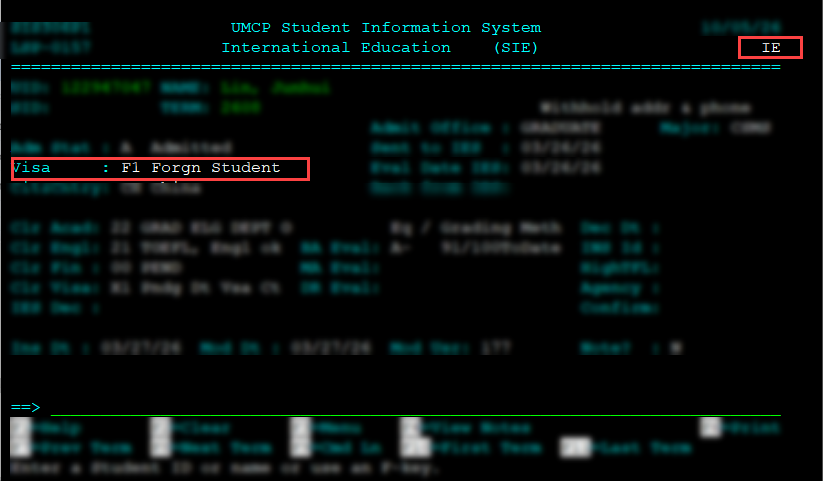
- SIS - The student's Visa status can be found on the SIS>IE (International Education) screen. On the left side, there is a field titled Visa. The Visa status will show F-1 Forgn Student or J-1 Forgn student.
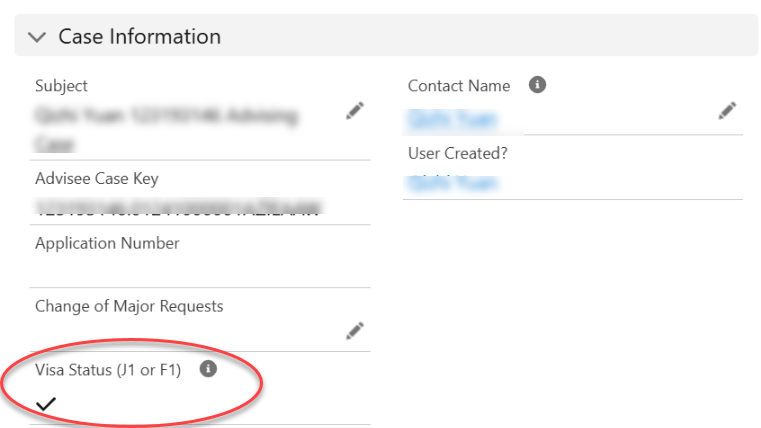
- TerpEngage - The student's Visa status can be found under Case Information>Visa Status (J-1 or F-1). The box will be checked accordingly.
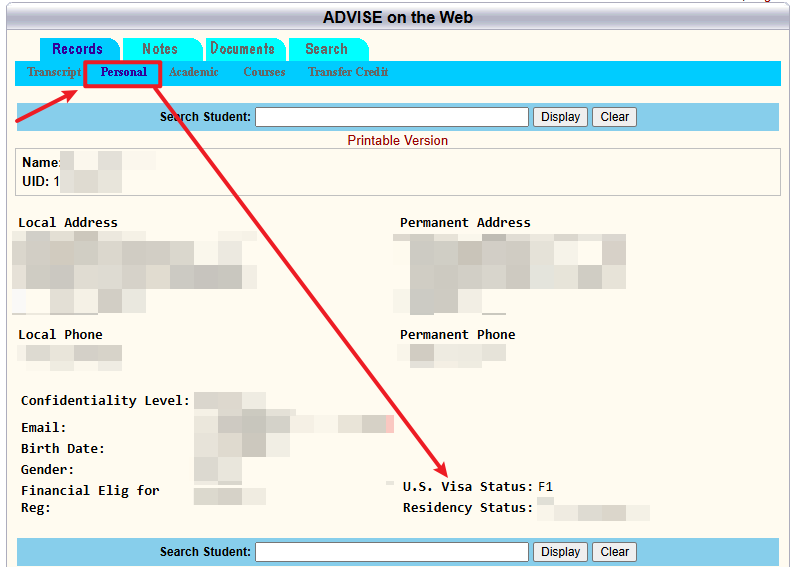
ADVISE on the Web - The default page is Transcript. Select Personal from the top menu to view the student’s visa status.
International students often navigate two important challenges at the same time:
- adhering to immigration regulations and
- navigating an educational system that has a different structure, values, and beliefs from the one they may be familiar with in their home country. Academic expectations, classroom norms, communication styles, and even the role of an academic advisor may be unfamiliar to some students.
Supporting international students, therefore, requires a shared effort. Academic advisors and campus partners help students navigate academic requirements and university processes, while ISSS provides immigration advising and federal reporting for our international students.
Immigration regulations can change without notice, and sometimes procedures involved with F-1/J-1 visa holders are far more complicated than they might appear. For this reason, we kindly ask academic advisors to redirect students to ISSS for any immigration issues or academic issues that may impact a student’s full-time enrollment or immigration status at UMD.
International Students and Scholar Services (ISSS) serves as the university’s liaison between F-1/J-1 students and government immigration services. A strong partnership among students, academic advisors, and ISSS advisors is critical for helping students navigate immigration regulations successfully.
- F-1/J-1 students must maintain full-time enrollment through the semester. Only one online course can be counted toward full-time enrollment. Advisors should keep these requirements in mind when helping students plan their schedules, or if they want to discuss the option of withdrawing from courses.
- International students who were admitted with English provisions must register for courses with the Maryland English Institute (MEI) (provisions are noted on their admission letter). Advisors should help students plan their schedules around the required MEI course (see English Requirements and Support). For undergraduates, this information would be self-reported by the student.
- F-1/J-1 students can never allow their immigration documents to expire. I-20/DS-2019 extensions are always required prior to their expiration date. Students needing additional time may ask their advisor to confirm their expected completion date or provide departmental supporting documentation (see Requests That Come to You in iTerp).
- F-1/J-1 students must plan the next steps they need to take in their final semester. Students with fewer than full-time credits remaining will need advisor confirmation for a reduced course load (see Final Semester)
- F-1/J-1 students may work on campus up to 20 hours per week during the semester (J-1 students need a letter from ISSS). Any off-campus employment, paid or unpaid, requires authorization and must be in the student's field of study. Advisors should refer employment authorization questions to ISSS.
ISSS serves as the university's compliance reporting office. With access to the Student Exchange Visitor Information System (SEVIS), ISSS is responsible for fulfilling federally mandated reporting requirements.
ISSS is required to:
- report the arrival of each new F-1 and J-1 student; students must complete an immigration document check during the drop/add period, and students who do not arrive must be canceled in SEVIS
- report each F-1 and J-1 student’s full-time enrollment during the drop/add period of each required semester
- update SEVIS when a student changes major, changes degree level, or completes a program earlier than expected
- report when a student transfers to another institution
- report when a student graduates or leaves a program without completing it
- update address changes reported within 10 days of a move; Testudo updates feed into iTerp and are then updated in SEVIS
ISSS meets these reporting requirements by emailing students before the start of the semester to remind them of their full-time registration requirement. Other required updates are fed to ISSS through SEVIS and are updated automatically through data feeds.
Visa
A U.S. visa is an official designation under U.S. Immigration law that determines a foreign national's eligibility to enter the country based on the specific purpose of their travel.
The visa must be applied for at a U.S. embassy and is a physical stamp placed inside the passport.
Immigration status
Immigration status refers to the legal classification assigned to a non-citizen when entering the U.S. The determination is based on the intended purpose of the entry.
Some international students have attended high school in the U.S. under the visa designation of their parents. These students may continue to remain under the dependent status of their parents while attending UMD. Examples include A, G, and H-4 dependent statuses.
Most of our international students enter on F-1 status, which is for the sole purpose of full-time study.
ISSS is responsible for the immigration compliance for only the F-1/J-1 students for whom we have issued immigration documents. Students under other immigration statuses do not work with ISSS unless they wish to change their status to F-1/J-1
I-20
An I-20 is a form required for students who hold F-1 status. The form is issued by ISSS from SEVIS, the Department of Homeland Security database. The I-20 serves as legal evidence of the student’s admission to the University and remains valid through their presence in the U.S. in F-1 status.
The I-20 includes information such as:
- Program name and CIP code (Classification of Instructional Programs)
- Program start and estimated end date
- Financial information for one academic year
- Holds signatures from ISSS that give permission to travel outside the U.S.
The majority of our degree-seeking international students enter the U.S. as F-1 students.
DS-2019
A DS-2019 is a form required for students who hold J-1 status. The form is issued by ISSS from SEVIS, the Department of Homeland Security database. The DS-2019 serves as legal evidence of the student’s admission to the University and remains valid through their presence in the U.S. in J-1 status.
The DS-2019 includes information such as:
- Program name and CIP code (Classification of Instruction Programs-Dept of Ed code that most closely matches the UMD major)
- Program start and estimated end date
- Financial information for one academic year
- Holds signatures from ISSS that give permission to travel outside the U.S.
Our exchange students and some degree-seeking students who are financially sponsored by their home governments use J-1 status.
The Student Lifecycle
From admission and arrival through enrollment, standing, extensions, and employment.
To help advisors better understand the student experience, this section outlines the communication, resources, and required steps that typically take place before the start of the semester. Detailed information on ISSS pre-arrival activities for F-1/J-1 students can be found here.
ISSS has a pre-arrival team dedicated to supporting F-1/J-1 student transition to UMD. Once an international student is admitted, ISSS sends a welcome email asking whether the student will need immigration sponsorship from UMD in F-1 or J-1 status. Students who indicate that they have some other form of immigration sponsorship are removed from further pre-arrival communication from ISSS. Students who will join UMD on F-1 or J-1 immigration status will then work with the ISSS pre-arrival team on the steps necessary to enter the U.S.
Pre-arrival support typically includes:
- Webinars on receiving your immigration documents
- Webinars on orientations available to new students
- Webinars with current international students
- A 10 week series “Tips of the Week” that highlights important information
- Online ISSS orientation
- Welcome events held before the start of the semester
- Required completion of the immigration document check upon arrival
Most international students are only allowed to enter the U.S within 30 days of the program start date listed on their I-20 or DS-2019 immigration document. This program start date is typically set a few days before the beginning of the semester to allow time for orientation, arrival tasks, and obtaining university identification. Students who are already in the United States and transferring from another U.S. institution may be eligible to arrive earlier.
Students are encouraged to arrive before the start of the semester. This allows a student time to adjust to a new academic, cultural, and living environment. Students are permitted to arrive no later than the drop/add period, but only with the support of their departments.
Departments and students should be aware that students who arrive late may miss important orientation programming, campus onboarding, and the opportunity to settle in before classes begin. As a result, late arrival can make both academic adjustment and immigration check-in more difficult.
More information about late arrivals, deferrals and support letters can be found on our late arrival website.
Undergraduate and Graduate Admissions maintain minimum English proficiency requirements for all non-native English speakers. Students who do not meet minimum English proficiency may be admitted with placement into certain English support programs, and that requirement will be noted in the student’s official admission letter.
For undergraduates, the Office of Undergraduate Admissions determines placement. The accepted proficiency tests and the categories that can waive the requirement are on the Undergraduate Admissions English Language Proficiency page.
For graduate students, the Graduate School determines placement and states it in the official admission letter as Intensive English, the English Bridge Program, or Advanced English Writing. Placement details and the deadlines for submitting new scores are on the Graduate School English Language Requirements for Enrollment page.
The Maryland English Institute (MEI) provides support courses for admitted students. Depending on the student’s admission status and placement, a student may be required to enroll in Intensive English, the English Bridge Program, or Advanced English Writing.
At the same time, advisors should keep in mind that a test score reflects proficiency at a particular point in time. Some students who are not required to enroll in English support courses may still benefit from additional language support, especially during their first year at UMD. Continued development in academic reading, writing, speaking, and listening is a normal part of adjusting to a new academic environment.
Intensive English (IE)
Students may be admitted to the Intensive English program in two ways:
- through UMD’s admission process for a degree program, or
- through an independent application directly to MEI
There are three intensive English sessions per year: fall, spring, and a seven-week summer session. Each consists of approximately 18 hours of instruction weekly.
Students admitted with a placement of Intensive English will be registered by the Maryland English Institute for their designated course.
English Bridge Program (EBP)
Students admitted with an English Bridge requirement are required to take UMEI005 in their first semester and must pass the course within one year to become fully admitted.
UMEI005 course sections meet four days per week, two hours per day. Undergraduates may enroll in two additional courses totaling eight credits. After a student successfully completes the Bridge program, ISSS updates the student's I-20 to reflect their academic program.
Advanced English Writing (AEW) for Graduate Students
Graduate students who are admitted with placement in the Advanced English Writing Course receive full admission to their degree program with the condition that they successfully complete the Advanced English Writing Course at the Maryland English Institute during their second semester of study.
Students with this placement must register themselves for UMEI507, Advanced Writing for International Students. To successfully complete UMEI507, students must satisfy the course requirements and achieve an acceptable score on the Maryland English Writing Test (MEWT) at the end of the semester.
Additional English Support
The EnGen-UMD Bridge Program
The EnGen-UMD Bridge Program (formerly the VOXY-UMD Bridge Program) is a two-month online course designed to improve the English language skills of newly admitted applicants to the University of Maryland in order to enable them to test out of the English Bridge Program. It is geared towards those applicants with a TOEFL/IELTS/PTE score in the range requiring placement in the English Bridge Program.
Upon completion of the two-month program, students may retake the TOEFL/IELTS/PTE and submit a new score to the Graduate School to determine if placement in the English Bridge Program for the Fall semester can be waived. Please visit the program website for more information and to sign up for the program. Students should be reminded that score receipt deadlines still apply, regardless of when they begin the EnGen-UMD Bridge Program. Students must plan their test date accordingly so that their scores are received by the Graduate School in time for the deadline.
ENGL101X
Students self-select into ENGL101X. Sections of 101X are capped at 18 students, and the rosters comprise students with English language learners and English-as-a-second-language backgrounds. There are no registration blocks or overrides required for students to register. This document provides additional information about English 101X.
Writing Center
Undergraduate students
- The Writing Center works with UMD undergraduates by providing consultations through different delivery modes: in-person and online (synchronous and asynchronous).
Graduate students
- The Graduate School Center for Writing and Oral Communication (CWOC) offers consultations about writing and oral communication across the graduate community.
Undergraduate Students
Transfer Credit Services (TCS) posts all undergraduate international transfer credits to student records and oversees the transfer evaluation process for all transfer courses. More details about the evaluation process can be found on their website. Students also receive transfer credit information at the point of admission (Admitted Student Checklists) and again as part of their pre-Orientation modules.
International Degrees and General Education
International Degrees: Per the UMD Academic Catalog, “a student who has earned a baccalaureate degree from an international institution that is recognized by that country’s ministry of education and the degree has been determined, by an approved third-party evaluator, to be equivalent to a baccalaureate degree in the United States has completed all general education requirements at the University of Maryland.”
Such degrees may be listed in SIS (PI screen) as “Bachelor of Other (B.O.).” If the student’s degree audit does not recognize the B.O. degree, advisors should contact the uAchieve team in the Office of the University Registrar for assistance with a manual correction.
Graduate students
Graduate students should work with their academic department to discuss transfer credit eligibility.
For master’s students, transfer credit may be accepted if it meets the Graduate School’s criteria. To be eligible:
- the student must have earned a grade of B- or better in the course
- the credits must not have been used to fulfill requirements for another degree
Students who meet these conditions may submit the Request for Transfer or Inclusion of Credit for Master’s Degrees form to their academic department, along with all required documentation.
Fall/Spring
F-1/J-1 international students must take a full-time credit load:
- Undergraduate students must enroll in at least 12 credit hours.
- Graduate students must enroll in at least 48 units.
Graduate assistantships provide additional registration units:
- 12 units for a 10-hour half-time assistantship
- 24 units for a 20-hour full-time assistantship
Students can count one online course toward the full-time minimum requirement. Hybrid courses are considered in-person for immigration purposes.
Advisors should not recommend that an F-1 or J-1 student withdraw from a course if doing so would reduce the student below full-time enrollment. Before dropping a course, the student should be referred to ISSS to determine whether the student may be eligible for a reduced course load authorization.
Students in F-1 and J-1 status may receive an incomplete grade. In some cases, ISSS may request a copy of the incomplete contract. However, a final grade must be entered before the end of the student’s final semester in the program. Incomplete grades in a student’s final semester may have immigration consequences, so students in this situation should work directly with ISSS.
Retroactive changes to course registration are not permitted if they would affect full-time enrollment. A W received at the end of the semester is treated the same as if the student had dropped the course during the term for immigration purposes.
Students may concurrently enroll in courses at another institution during the semester, but they must continue to maintain full-time status through UMD.
Summer and Winter Enrollment
Summer and winter are typically optional terms, and students in F-1 and J-1 status are generally not required to enroll during these sessions. During official academic breaks, students may enroll in courses at another institution without special permission from ISSS, but they must still obtain approval from their advising college through the Permission to Enroll (PTE) process. Summer/winter transfer credit maximum limits are still in effect.
Undergraduate students taking courses at domestic/U.S.-based institutions should first verify that the course(s) they intend to take will transfer by reviewing the Transfer Course Database before submitting a PTE form. The PTE form must be approved in order to receive credit.
If a student will complete the degree in summer or winter, registration is required, and the final course must be completed in person.
Undergraduate students taking courses at international institutions must first contact Transfer Credit Services (TCS), as this process includes additional steps.
If the student wants to take courses at an institution within their home country (per Permanent Address in SIS), then they must follow the steps below:
- Contact TCS and provide the name of the institution, semester they intend to study there, course ID and title, and a copy of the syllabus. TCS will then confirm if the institution is accredited and has the student’s course(s) evaluated, if they are not already in the database. During this time, students must obtain a letter from the institution confirming the teaching mode for each course (online or in-person).
- Once their courses are approved for transfer and the teaching mode confirmation is received in TCS, the student will then submit a PTE form to their advising college with the TCS-Student email thread and teaching mode letter attached. This email thread serves as confirmation that their courses will transfer, but TCS will also forward this confirmation to the advising college.
- Their PTE form must be approved before the student can register for courses abroad.
- Following completion of their courses, students must have their official transcript submitted to one of the accepted international credential evaluators listed on the TCS website (under “International Transfer Credit”). These companies convert the grades and credits into the U.S. grade/credit system. Please note that these companies charge a fee for this service. Students must be sure to select the correct report option as listed on the TCS website.
- Once completed, the student will request that the credential evaluator forward their report and have a copy of their official transcript sent to UMD. The credential evaluators should already have an electronic destination address in their records for UMD. Electronic transcripts can be sent to TCS, but must come directly from the institution.
If the student wants to take courses at an institution not within their home country, but outside of the United States, then they must contact the Education Abroad Office, as they will follow the standard SACA process.
Final Semester
If a student has fewer credits than full-time remaining to complete the degree, the student can request authorization for a reduced course load. F-1/J-1 students initiate the part-time authorization form in iTerp and include their academic advisor’s email address in the request. ISSS then forwards the request to the advisor to confirm the student’s remaining degree requirements.
All F-1/J-1 students must receive approval from ISSS before dropping below full-time enrollment. The deadline is the end of the schedule adjustment period.
Online Limits
F-1/J-1 students may count only one online course toward their full-time enrollment requirement each semester. Credits above the minimum may be taken online. Students and advisors must be cautious when dropping classes so that face-to-face courses needed to maintain status are not dropped inadvertently.
If a student has only one class remaining in order to graduate, that class cannot be fully online.
Example: A UG student is enrolled in 15 credits, and two courses are online. This is permissible because only one online course is being used to meet the 12-credit full-time requirement. If the student wants to drop 3 credits, they may drop only one of the online courses.
A graduate student is enrolled in 48 units: 3 credits are in person, 3 credits are hybrid, and 3 credits are online. This is permissible because the student is using only one online course toward the full-time requirement. Hybrid courses are considered in-person.
Other Reasons for a Reduced Course Load
Immigration regulations require international students to complete a full course of study each term during the academic year, but there are some situations in which a student may need to drop below full-time or fully withdraw. A student may request a Reduced Course Load (RCL) from ISSS if they meet the criteria outlined by immigration regulations. If you have questions about Reduced Course Loads, please contact isss@umd.edu.
Examples include:
- Illness or medical condition (students must submit the Part-Time Authorization/Online Accommodations Form for Medical Reasons)
- Initial difficulty with the English language (first semester only)
- Initial difficulty with reading requirements (first semester only)
- Unfamiliarity with American teaching methods (first semester only)
- Improper course level placement (error made by UMD)
- Completing your intended program in the current term
*ISSS must approve the application for Reduced Course load before the student drops below a full course load.
Graduate Students in 12-Week Term Programs
Students in 12-week term programs are required to register each term and do not have vacation periods. For these programs, 36 units are considered full-time.
Graduate Students in Business Programs
Graduate business programs (Smith MS and MBA) run on an A, B, C, and D term structure rather than standard fall and spring semesters, so full-time enrollment is defined differently for these students. Full details are in the ISSS handout, Maintaining Status: Full-time Enrollment for F-1 MS/MBA Business students.
Registration Holds
There are no specific registration holds due to F-1/J-1 status.
- Advisors receive a warning in SIS regarding full-time registration requirements.
- Warning appears in PUBLIC, DA, MSE, SP
- F-1/J-1 students who attempt to withdraw from a course on their own in Testudo also receive a warning message.
- F-1/J-1 students are subject to the same registration blocks as all students. Some of the more common holds include:
- New student requires advising
- Immunization blocks
- Financial holds
Graduate Students
Common additional holds for graduate students include:
- Missing transcript: the Graduate School has not received the student's final international transcript.
- Graduation admission expired: the student exceeded the time limitation for their degree. Students who are nearing their graduation admission limits must extend them before seeking an extension with ISSS.
Academic standing can have important immigration consequences for students in F-1 and J-1 status.
If a student is suspended and, as a result, is unable to enroll in the following semester or maintain full-time enrollment in the current semester, the student may fall out of status. Because students in F-1 and J-1 status are required to maintain full-time enrollment during required terms, advisors should refer any student who may be at risk of suspension to ISSS as early as possible so that available options can be reviewed.
Students placed on probation may generally remain in their current immigration status, provided they are still able to maintain full-time enrollment. However, if a student’s academic difficulties may lead to suspension, dismissal, or an inability to enroll full-time, the student should be referred to ISSS to discuss possible immigration implications.
Employment is broadly defined by U.S. immigration regulations and may include work that is paid or unpaid, full-time or part-time, and in some cases even activity described as volunteer work if it primarily benefits an employer or organization. Because students in F-1 and J-1 status are in the United States primarily for study, employment is subject to strict federal rules.
Advisors should encourage students to review the ISSS employment website and to consult ISSS before accepting any employment offer, internship, assistantship, or other work opportunity.
On-Campus Employment
- F-1/J-1 students are permitted to work up to 20 hours per week during the fall/spring semester. Assistantships do count towards this maximum. F-1 students do not need additional employment authorization on the Form I-20 for on-campus work, but J-1 students are required to obtain authorization from ISSS before beginning on-campus employment.
- During official university breaks, students in F-1 and J-1 status may generally work more than 20 hours per week, if otherwise eligible.
Off-Campus Employment
Any off-campus employment, whether paid or unpaid, requires special work authorization and is generally limited to work in the student’s field of study.
F-1/J-1 students should review the ISSS webpage on work authorization and contact ISSS with any questions before accepting any job offer.
F-1 students wishing to participate in an off-campus training program that is an integral part of an established curriculum must first obtain work authorization known as CPT. The training is defined as an alternative work/study, internship, cooperative education, or any other type of required internship or practicum which is offered by sponsoring employers through cooperative agreements with the school, and must be in the student's major field of study. Students must obtain CPT authorization BEFORE they begin working in any paid or unpaid experience.
The CPT website covers the detailed process students follow to gain permission prior to engaging in the internships.
- Given ongoing policy changes, academic advisors should direct students to the CPT website and to ISSS for current CPT requirements before committing to a start date, rather than relying on previous students’ experiences. Once students have done so, advisors can assist them in completing any departmental academic or registration requirements that may apply.
- Some CPT applications require their academic advisor’s contact information in iTerp, and the advisor receives a request for academic verification (see “Requests That Come to You in iTerp”). Advisors should respond promptly, as students may not begin work until ISSS has approved the request and issued CPT authorization.
Optional Practical Training (OPT) is a temporary work authorization that allows students in F-1 status to work in the U.S. for up to 12 months in a job directly related to their major field of study. Students in eligible STEM fields may qualify for an additional 24 months of OPT.
Academic advisors are required to complete a form in iTerp confirming a student’s current GPA and readiness to complete a program of study (See “Requests That Come to You in iTerp” for more information). Students provide their advisor’s contact information when applying, and iTerp generates an email to the advisor requesting confirmation of the student’s final degree requirements. Students whose GPA is below the minimum requirement are encouraged to wait to apply for OPT until they are confident their final GPA will meet graduation requirements. Students who apply before meeting those requirements risk losing this immigration benefit if they are unable to graduate.
Immigration end dates are determined by the completion of final required coursework or by the semester end date when a thesis or dissertation is submitted. Students who complete final requirements in summer or winter are considered to have completed their degree at that time, regardless of when the degree is officially conferred.
Completion Term vs. Degree Clearance
For OPT, the date that matters is when a student completes their final degree requirements, not the official graduation or conferral date. This is a common source of confusion. A student who misses a term's degree-clearance deadline but still completes their requirements before the end of that semester (for example, defending after the clearance deadline but before the semester ends) may still apply for OPT on the normal timeline. When in doubt, advisors should refer the student to ISSS before the student applies for OPT.
A program extension is required when a student needs more time to complete the degree than is currently reflected on the student’s Form I-20 or DS-2019. The program extension form serves as documented evidence that the student needs additional time to complete the program beyond what was originally anticipated.
ISSS sends reminders to students about their upcoming document expiration 90, 60, 30, and 7 days in advance. Extensions may be granted for up to one year at a time. If additional time is needed, the student must request another program extension at the end of that I-20 or DS-2019 period.
- The student starts the form in iTerp
- The student includes the academic advisor, program director or PhD advisor’s email
- The academic advisor must complete the form in iTerp and indicate what academic courses or requirements remain in the program (See Requests That Come to You in iTerp” for more information)
- The program extension form must be completed and returned to ISSS before the student’s I-20 expires, typically by the end of the current semester for which the extension is requested
Resources and Support
Contacts, involvement opportunities, resources and more.
U.S. immigration regulations impact numerous aspects of a student’s life. These regulations are often difficult to interpret and change often. When students have questions about the following areas, it’s best to refer them to ISSS:
- registering for less than a full course load at UMD or dropping below full time
- taking a leave of absence
- Possible dismissal
- Difficulty understanding what is expected, not seeming to adjust to US teaching methods
- Feeling isolated
- off-campus employment
- traveling outside the U.S.
Students work with ISSS through a variety of platforms, including virtual and in-person appointments, chat, and email.
Students use the ISSS schedule an appointment link to book in-person or virtual appointments. Students are not assigned to a specific ISSS advisor; they may book the first available appointment or schedule with a particular staff member.
University faculty and staff can reach ISSS staff via our staff directory, which includes staff emails and direct office phone numbers. Faculty and staff may also use ISSS chat during operating hours; the chat is staffed by ISSS advisors.
English Conversation Partners (ECP)
Participants meet with their fluent English-speaking volunteer in group sessions. Provides a small group setting to practice English and is a great way to meet new friends. Participants commit to 60 minute weekly conversations for 10 weeks.
ISSS is always looking for volunteers to lead a group, sign up as a facilitator!
International Coffee Hour is a great way to connect with domestic and international students and scholars. It provides a low stress venue for students to meet new people. ISSS staff is present to answer general questions during the coffee hour.
International Student Council (ISC)
ISC is a group of international student representatives selected to provide insight and feedback to ISSS and other campus units. UMD faculty and staff are encouraged to refer solutions oriented students to apply. The counsel provides a meaningful opportunity for leadership development and builds a connected and vibrant international community at UMD.
International Orientation Leaders (IOLS)
IOLS are UMD undergraduate and graduate students who facilitate a support system for new international students. IOLS help new students transition into the new academic environment and play a critical role in creating an inclusive campus experience by hosting virtual pre-arrival engagements and leading activities during the on campus welcome events.
Academic advisors may receive several types of requests through iTerp that require review or confirmation of academic information. Common examples include re-enrollment requests, CPT/OPT applications, I-20 extension requests, and part-time enrollment requests.
Re-Enrollment
This request asks you to confirm basic student and academic information in iTerp, such as the student’s coursework and expected graduation term.
CPT/OPT Applications
- Number of credits/courses you are taking this semester
- Expected date of thesis/dissertation defense
- Expected date of thesis/dissertation electronic submission (Required)
I-20 Extension Request
- Basis for Extension Request*
- Loss of Credits Upon Transferring to the University of Maryland
- Change of Major
- Change in Research Topic
- Unexpected Research Problems
- Medical Condition
- Other Compelling Academic Reasons
- MEI (Maryland English Institute)
- Student is expected to complete program of study by*
- List courses remaining for degree completion
- Does this student have a required Dissertation or Thesis?* Yes/No
- Will the upcoming term be the student's final semester?* Yes/No
- Please provide any information about the academic or medical circumstances that have led to the student needing more time to complete the degree.*
- Has the student been making normal progress towards the completion of their degree program?*
- Do you recommend that this student be given additional time to continue their study?*
Part-Time Authorization
- Basis for part-time authorization
- Academic term for part-time status
- Recommended number of credit hours
- Anticipated degree completion date
- The impact of academic Advising Activities on International Students’ sense of Belonging
- International student related article from NACADA
- “Belonging is a luxury to us”