
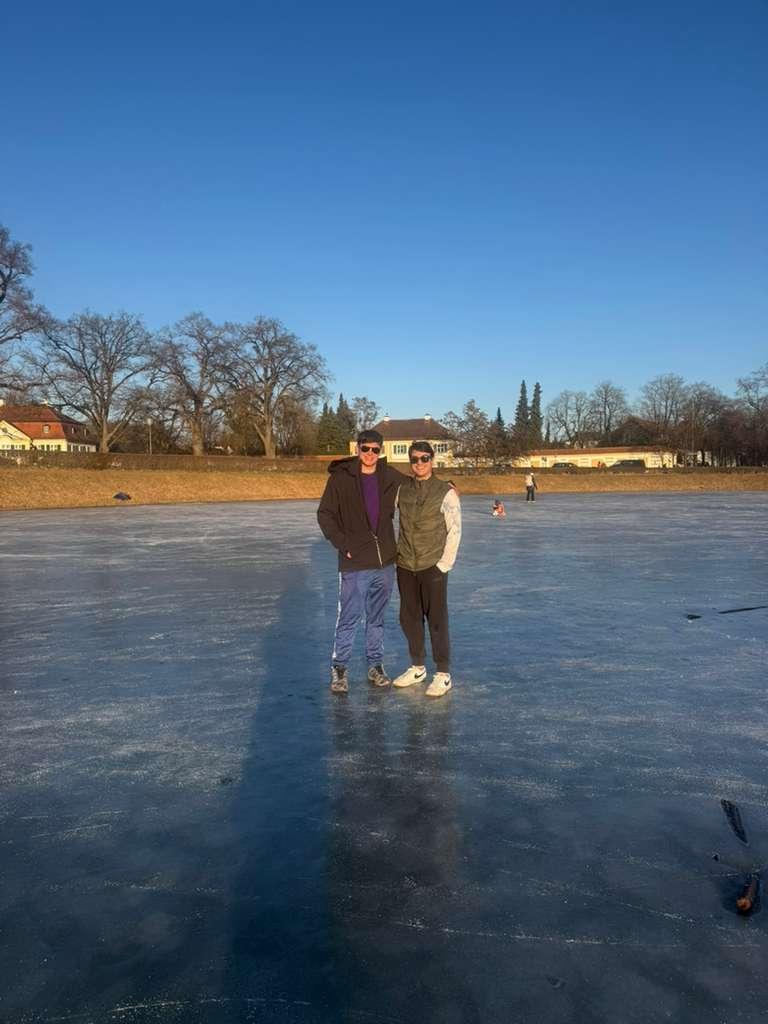
Daniel Prins
Program: UMD-Winter: Germany: A Green Giant? Environmentalism and Technology in Germany, Today and Yesterday
Term: Winter 2026
Major: Electrical Engineering, College Park Scholars
For engineering student Daniel Prins, studying abroad in Germany offered the opportunity to see how innovation, infrastructure and history intersect on a global scale.
“The most rewarding aspect of study abroad was learning all the different ways that Munich has balanced preserving history while also looking to the future,” he shared. From the adaptive reuse of historic buildings — including former Nazi-era structures now repurposed as arts institutions and museums — to the city’s forward-thinking infrastructure, he saw how history and innovation coexist.
As an engineering student, one experience stood out in particular.
“We were able to visit the BMW manufacturing plant in Munich where they produced electric vehicles, and I was able to see some of the devices that were designed by electrical engineers. This reignited my passion for the automotive industry, especially as it moves towards electric systems.”
Of course, not every lesson happened in a classroom or factory. Prins’s advice for future study abroad Terps?
“Know that you won't know everything. You may think you are prepared for a culture, but things will be very different from what you originally thought.”
One of his biggest challenges was navigation. While Germany’s public transportation system was efficient, figuring out where to get off, in another language, required patience and adaptability. At the same time, Prins was struck by how clean and orderly everything felt, especially compared to what he was used to in the U.S.
Beyond engineering and infrastructure, the experience also included moments of awe.
“If I hadn’t studied abroad, I would have never seen some of Einstein's handwritten letters.”
From historic archives to cutting-edge electric vehicle manufacturing, Prin’s winter in Germany offered both perspective and inspiration — proof that studying abroad can shape how engineers see both the past and the future.